
How Do You Know If You Have Piles? Signs You Should Not Ignore
Bleeding during a bowel movement, persistent itching around the anus, or a sensation that something is protruding are often the first signs of piles. According to Dr. Dipesh Thacker, a piles doctor in Bhuj, Gujarat, these symptoms are commonly ignored or mistaken for temporary discomfort, causing many patients to delay treatment until the condition becomes more severe.
Practicing at Akshar Hospital since 2013, Dr. Dipesh regularly treats patients who have been living with piles for months before seeking medical help. In this article, he explains the early symptoms of piles, what they actually feel like, and when it is time to stop guessing and get examined.
What Are Piles, in Simple Terms?
Bleeding during a bowel movement, persistent itching around the anus, or a sensation that something is protruding are often the first signs of piles. According to Dr. Dipesh Thacker, a piles doctor in Bhuj, Gujarat, these symptoms are commonly ignored or mistaken for temporary discomfort, causing many patients to delay treatment until the condition becomes more severe.
Practicing at Akshar Hospital since 2013, Dr. Dipesh regularly treats patients who have been living with piles for months before seeking medical help. In this article, he explains the early symptoms of piles, what they actually feel like, and when it is time to stop guessing and get examined.
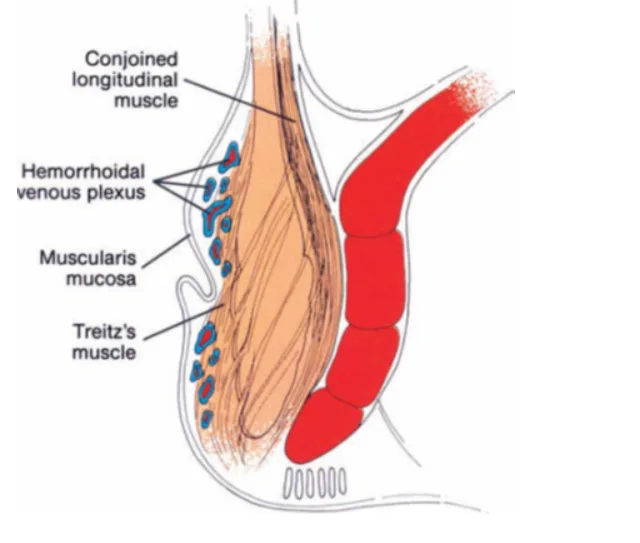
When these cushions becomes symptomatic, they cause a range of symptoms – from mild discomfort to significant pain and bleeding.
There are three main types:
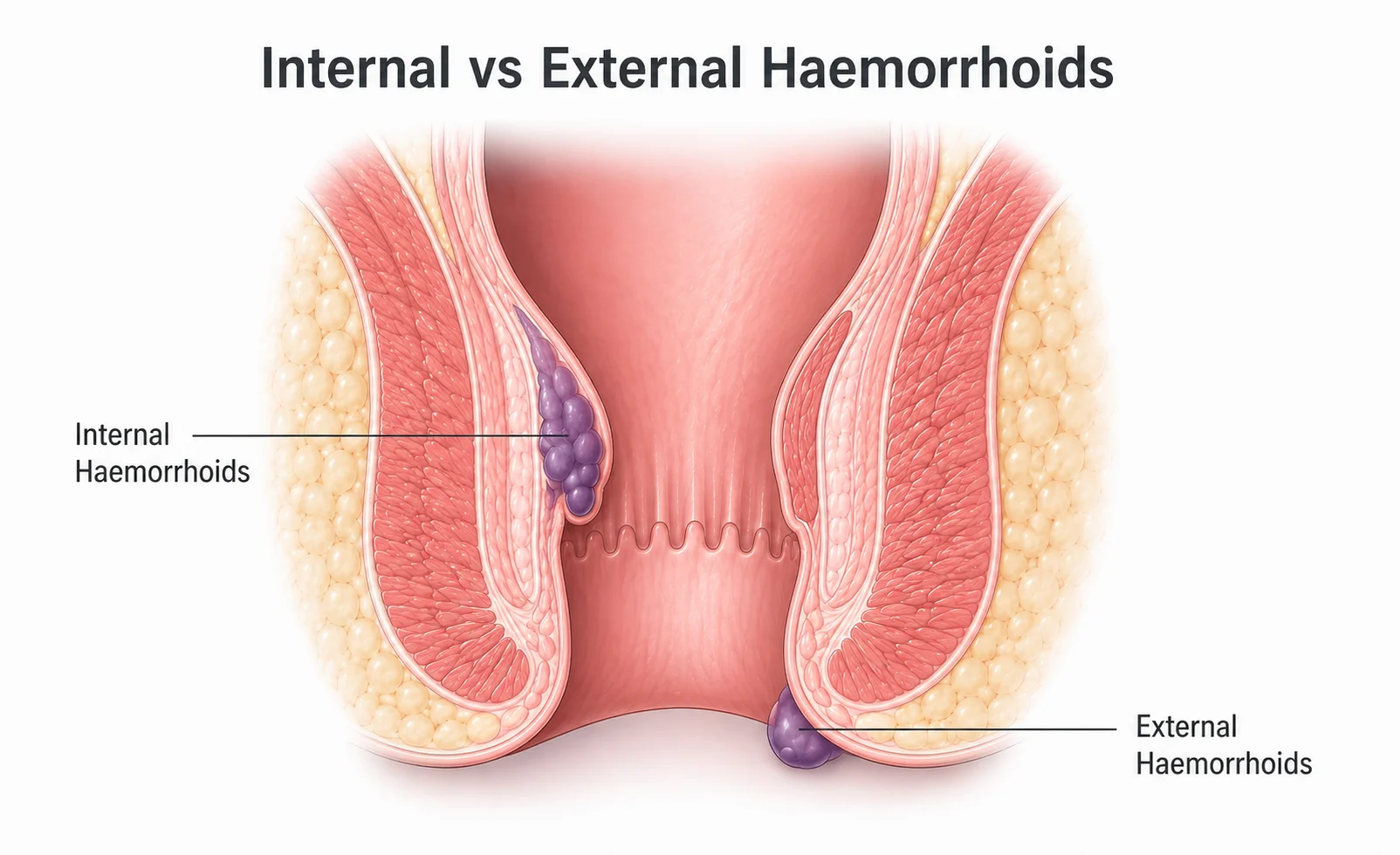
Internal piles develop inside the rectum. They are usually not visible and often not painful, but they bleed.
External piles form under the skin around the anus. These are more likely to cause pain, swelling, and itching.
Mixed piles are a combination of both internal and external piles at the same time. This is actually the most common presentation – patients experience bleeding, pain, swelling, and itching all together, making it more uncomfortable than either type alone.
A basic infographic of symptoms of piles
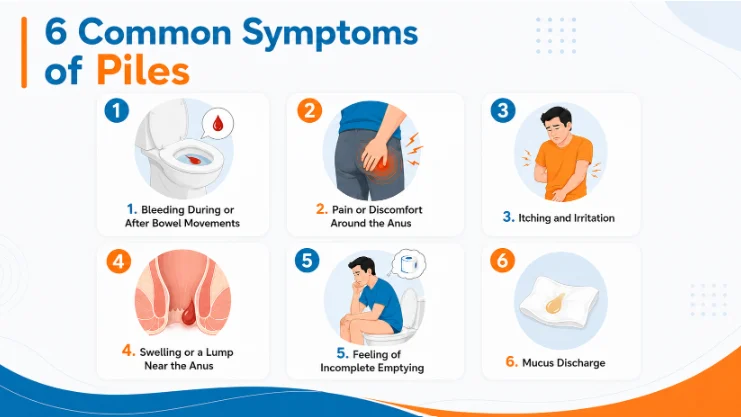
Piles do not always announce themselves loudly. For many people, the symptoms start mild and are easy to brush off. Here are the most common signs to watch for:
Bleeding During or After Bowel Movements
This is the most common and often the first sign. The blood is usually bright red and appears on toilet paper, on the stool, or in the toilet bowl. It is not mixed into the stool – that is an important distinction. Bleeding that is dark or mixed with stool needs urgent medical attention as it may indicate something other than piles.
Pain or Discomfort Around the Anus
External piles and thrombosed piles (where a blood clot forms) can cause a sharp, persistent pain. Internal piles, on the other hand, are usually painless. If you have pain and bleeding together, it is important to get examined to confirm what is causing it.
Itching and Irritation
A persistent itch around the anus, especially after bowel movements, is a very common complaint with piles. It happens because piles can cause mucus discharge that irritates the surrounding skin.
Swelling or a Lump Near the Anus
A soft, tender lump near the anus is often an external pile or a prolapsed internal pile. If it is hard and very painful, it could be a thrombosed haemorrhoid, which needs prompt attention.
Feeling of Incomplete Emptying
Many patients with piles describe a sense that they have not fully emptied their bowels, even right after a bowel movement. This happens because the swollen tissue creates a sensation of fullness.
Mucus Discharge
A small amount of mucus after passing stools, or staining on underwear, can be a sign of internal piles that have begun to prolapse.
What Does Piles Pain Actually Feel Like?
This is one of the most common questions Dr. Dipesh hears. The honest answer is that it depends on the type and grade.
Internal piles are often completely painless. The only symptom may be bleeding. Many patients are surprised to learn they have Grade 2 piles with no pain at all.
External piles, on the other hand, can range from a dull ache and pressure to a sharp, throbbing pain – especially when sitting for long periods, during bowel movements, or after straining.
Mixed piles tend to be the most uncomfortable of the three since both sets of symptoms are present at the same time – bleeding from the internal component and pain, swelling, and itching from the external component together.
Thrombosed external piles are a specific situation where a blood clot forms inside an external pile, cutting off blood flow to that tissue. This causes a sudden, severe, throbbing pain along with a hard, tender lump near the anus that appears quite quickly. It is one of the more acutely painful presentations Dr. Dipesh sees and usually needs prompt attention.
Doctor Quote:
“Piles does not always mean pain. A lot of patients come in because of bleeding and are genuinely shocked when I tell them they have Grade 2 or Grade 3 piles with no significant pain. That is exactly why bleeding should never be ignored or assumed to be harmless.” – Dr. Dipesh Thacker, Akshar Hospital, Bhuj
The Four Grades of Piles - How Severe Is Yours?
Piles are graded from 1 to 4 based on severity. The grade determines the treatment approach, which is why proper examination matters.
|
Grade |
What Happens |
|
Grade 1 |
Small internal piles, no prolapse. Usually only symptom is bleeding. |
|
Grade 2 |
Prolapse during bowel movement but returns on its own. |
|
Grade 3 |
Prolapse during bowel movement and needs to be pushed back manually. |
|
Grade 4 |
Permanently prolapsed, cannot be pushed back. May be painful. |
Grades 1 and 2 can often be managed with conservative treatment. Grades 3 and 4 typically need procedural or surgical intervention.
Is It Piles or Something Else?
This is important. Not every case of rectal bleeding or anal discomfort is piles. Symptoms that overlap with piles can also be caused by:
- Anal fissure – a tear in the anal lining causing sharp pain and bleeding
- Perianal abscess – a collection of pus near the anus causing severe pain and swelling
- Anal fistula – an abnormal tract near the anus causing discharge and discomfort
- Colorectal polyps or, in rare cases, colorectal cancer
This is why self-diagnosis is risky. Bleeding from the anal region should always be evaluated by a specialist – not because it is always serious, but because an accurate diagnosis leads to the right treatment.
When Should You See a Doctor?
See a specialist if you notice any of the following:
- Bleeding from the anus, even if it seems minor or happens only once
- A lump near the anus that is painful or growing
- Symptoms that have not improved after two weeks of dietary changes and home care
- Pain that is severe or getting progressively worse
- Any change in bowel habits alongside rectal bleeding
Do not wait until the condition is significantly worse. Grade 1 and Grade 2 piles are far easier to treat than Grade 3 and Grade 4.
Doctor Quote:
“The most common thing I hear from patients is – I thought it would go away on its own. Sometimes it does. But more often, by the time they come to me, what started as a Grade 1 problem has become a Grade 3. Early consultation is always the better choice.” – Dr. Dipesh Thacker, Akshar Hospital, Bhuj
Conclusion
Piles are common, treatable, and nothing to be embarrassed about. The key is recognising the signs early and getting the right diagnosis before the condition progresses. If anything in this article sounds familiar – the bleeding, the itch, the discomfort – it is worth getting it checked.
Dr. Dipesh Thacker at Akshar Hospital, Bhuj has been helping patients with exactly these concerns since 2013. A consultation is straightforward, private, and gives you a clear answer – which is always better than guessing.
Frequently Asked Questions
Can piles go away without treatment?
Mild, acute piles sometimes improve with dietary changes – more fibre, more fluids, and avoiding straining. However, Grade 2 and above rarely resolve without medical intervention and tend to worsen over time. Early treatment avoids more invasive procedures later.
Is rectal bleeding always a sign of piles?
Not always. While piles are the most common cause of bright red rectal bleeding, an anal fissure, polyp, or other condition can also cause bleeding. Any rectal bleeding should be properly evaluated by a specialist.
Can I have piles without any pain?
Yes. Internal piles are often completely painless. Bleeding without pain is a very common presentation of Grade 1 and Grade 2 piles. Pain is more associated with external piles and thrombosed haemorrhoids.
What makes piles worse?
Chronic constipation, straining during bowel movements, prolonged sitting, low fibre diet, and inadequate fluid intake are the most common aggravating factors. Addressing these is part of any piles management plan.
How is piles diagnosed?
A specialist like Dr. Dipesh Thacker will take a detailed history of symptoms and perform a physical examination. In some cases, a proctoscopy may be used to examine the inside of the rectum. The process is straightforward and done in a private, respectful setting at Akshar Hospital, Bhuj.