
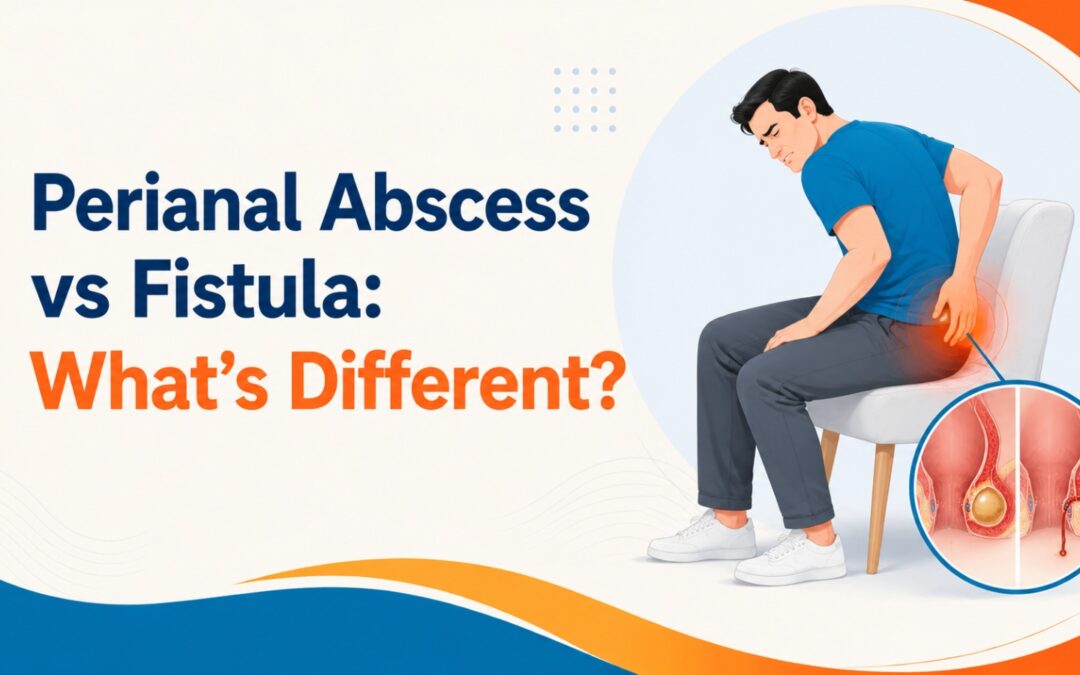
A perianal abscess is a sudden, painful pocket of pus, formed when an infected anal gland flares up fast. A fistula is different. It’s the tunnel left behind, running from that same gland out to an opening on the skin. Often just two stages of one disease, not two separate problems. About a third of untreated abscesses go this route within months.
According to Dr. Dipesh Thacker, piles doctor in Bhuj, Gujarat, “An abscess and a fistula are usually two stages of the same problem, not separate conditions. One shows up suddenly and needs draining right away. The other develops quietly afterward and needs a planned procedure, not a quick fix. Mistake one stage for the other, and treatment gets delayed.”
Don’t wait around hoping it drains on its own. Get it checked before an abscess turns into something that keeps coming back.
What is a perianal abscess and why does it form?
A perianal abscess starts as a blocked anal gland that gets infected. It comes on fast. Hurts even faster.
Sudden onset: Pain builds over a day or two, not weeks. Swelling and redness near the anus are usually the first sign.
Fever and discharge: A low grade fever, throbbing pain, sometimes pus. All of it points to an infection that’s spreading.
Common risk factors: Diabetes, Crohn’s disease, long term steroid use. All raise the odds. Constipation and poor hygiene don’t help either.
Not something to sit on: Warm baths won’t clear a true abscess. It needs incision and drainage. Plain and simple.
Fissures, abscesses, and fistulas often get mixed up because the symptoms overlap. If it turns out to be a fissure instead, fissure treatment follows a different approach entirely.
Piles vs fissure vs fistula: how do the symptoms actually compare?
Same infection. Two different stages. Here’s where they split.
| Feature | Perianal Abscess | Fistula |
|---|---|---|
| Nature | Acute pocket of pus | Chronic tunnel-like tract |
| Onset | Sudden, over days | Gradual, often after an abscess |
| Main symptom | Throbbing pain, swelling, fever | Persistent discharge, recurring swelling |
| Treatment | Incision and drainage | Kshara sutra, fistulotomy, or LIFT |
| Recurrence | Low once properly drained | Higher if the internal opening is missed |
Nature of the problem: An abscess is active infection. A fistula’s what’s left once that infection has partly healed on the surface.
Timeline: Abscesses demand attention within days. Fistulas can sit quiet for months before flaring up again.
What you’ll actually feel: Abscess pain is sharp and constant. Fistula symptoms come and go. Sometimes just an itch, sometimes discharge.
Why treatment differs: If a tract remains behind, it needs its own dedicated procedure. Otherwise it just comes back.
Piles isn’t the only anorectal condition that gets misread. For a closer look at the symptoms of piles, read How Do You Know If You Have Piles?
Why Choose Akshar Hospital?
Akshar Hospital has treated anorectal conditions in Bhuj since 2013, under Dr. Dipesh Thacker. He holds a Master’s degree in Shalyatantra, and trained further in Proctology at Mumbai’s ceMAST. His approach leans on Kshar Sutra, a traditional Ayurvedic technique he’s one of the few in Kutch trained to perform. Every case gets a proper diagnosis first, whether it’s a straightforward abscess or a complex, branching fistula.
Abscess and fistula cases are treated differently here too, because each stage needs its own approach. Dr. Dipesh explains what’s actually happening before recommending drainage, kshara sutra, or surgery. Patients travel from across Kutch and Gujarat for exactly this kind of clarity.
Frequently Asked Questions
Can a perianal abscess heal without any treatment?
No, it needs proper drainage and will not resolve on its own.
How long after an abscess does a fistula usually form?
Often within weeks to a few months if left untreated.
Does a fistula always follow an abscess?
No, only in about a third of untreated abscess cases.
Is Kshar Sutra treatment effective for fistula in Bhuj?
Yes, it is a low recurrence, time tested traditional method.
References:
Disclaimer: This blog is for general informational purposes only and is not a substitute for professional medical advice, diagnosis, or treatment.